Remembering Founder Mode
Weaponizing a founder's worst impulses
July 23, 2026 · 7 min read

TLDR: To run a great business, be a great leader.
(Obvious, right? 🙉)
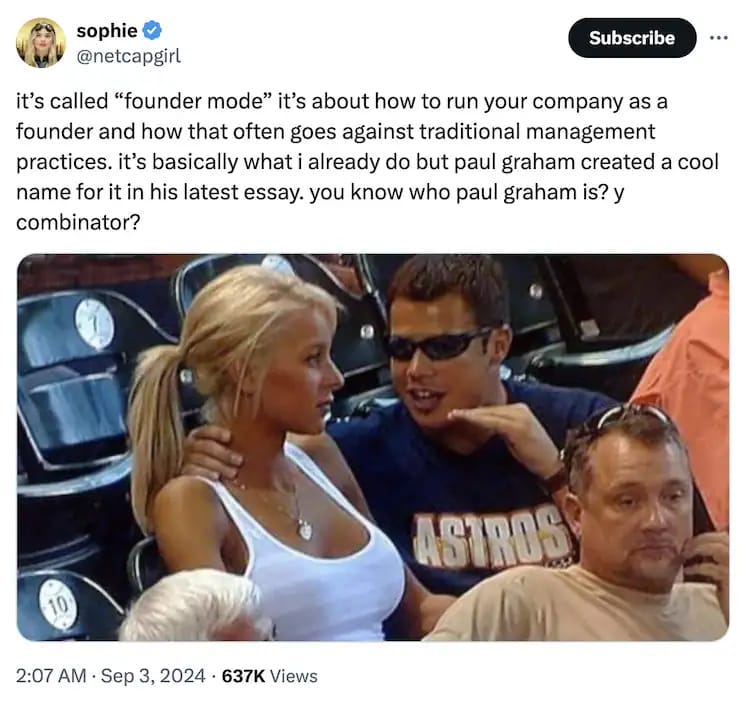
Remember that thing everyone was crazy about a year ago called Founder Mode? Here’s an article I wrote during its heyday. I think the lessons are more relevant than ever.
Let’s recap
If you’re in tech or on LinkedIn/X in unhealthy quantities, please indulge us.
For everyone else, let’s get you up to speed:
Paul Graham wrote an essay early this month on what someone over there at YC, maybe him, dubbed “founder mode.”
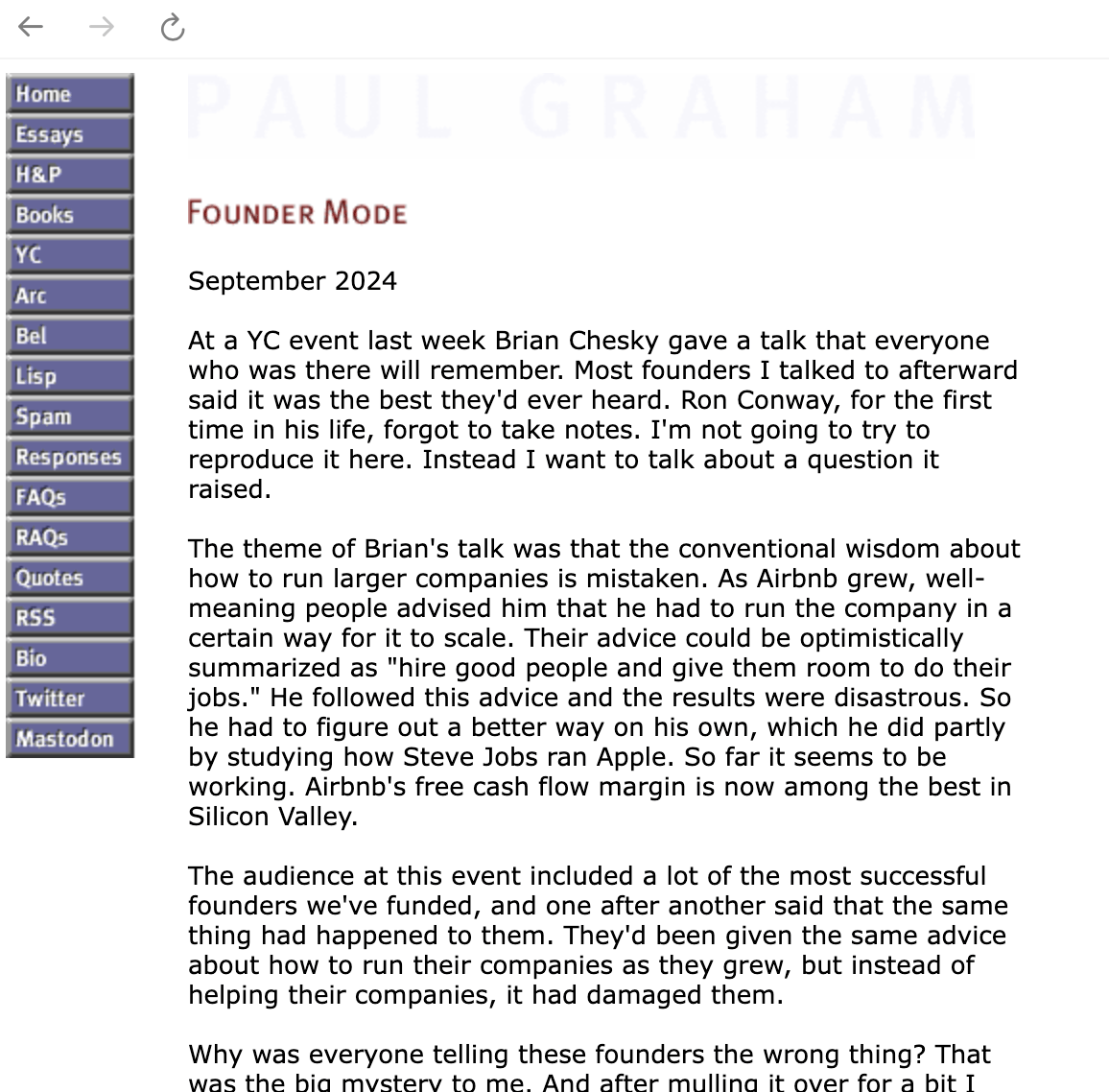
https://paulgraham.com/foundermode.html
And because it’s Paul Graham, most every influencer, founder, and investor has leapt at the chance to agree with him in order to curry favor or otherwise show their bona fides.
But a few of us demur. 😱
Not that Paul Graham needs my support 🤣 💸, but I’ll be fair: IMO he’s mainly pushing back on advice to founders to step back too much or too early.
This is sound. Being asleep at the wheel of a car going 100mph down the Frogger track with wooden tires on and jet-fuel fumes for gas — is not a prescription for success. 🤪 🐸
Cause that’s what startups are. 🔥 🏎️ [1]
And becoming Paul Graham’s version of a “manager” means you’re gonna take a triple dose of melatonin with a Delirium-Tremens chaser and go nighty-night supa quick. 🛌 🌚
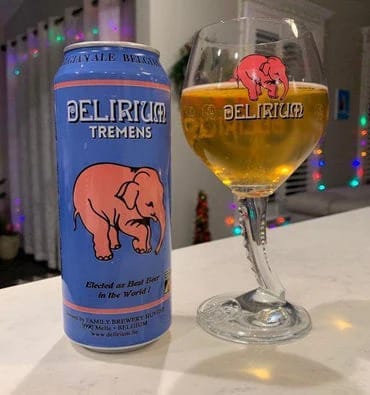
Awesome beer. Pack a lunch.
Yes, corporate bots and founders are so different, they’re like gorgonzola vs. “brie time baby.” [2]
Managers are primarily there to execute someone else’s vision.
I’m sorry if that offends you, but… truth. 🤷🏽♂️
Managers may be creative.
They may exercise initiative.
✋ But their scope is always smaller than their boss, and they seldom have full accountability.
Accountability rolls uphill
Meanwhile, founders are like the captain of a ship.
If the ship sinks due to storm or cannon, it’s their fault.
They might as well lash themselves to the mast and go the bottom of the sea.
So what’s the beef?
“There are some things only founders can do.”
Let’s all queue “Flight of the Valkyries” for the übermensch. 😇 👼🏻 🦅
Strictly speaking, yes, there are a couple things only founders can do. But this is like Louis XIV allegedly saying with respect to the rule of law, “I am the state.”
As in, if a founder does it, it is by definition right and good. 😳
Here are a couple other relevant quotes:
“Why was everyone telling these founders the wrong thing? That was the big mystery to me. And after mulling it over for a bit I figured out the answer: what they were being told was how to run a company you hadn’t founded — how to run a company if you’re merely a professional manager.”
“Hire good people and give them room to do their jobs. Sounds great when it’s described that way, doesn’t it? Except in practice, judging from the report of founder after founder, what this often turns out to mean is: hire professional fakers and let them drive the company into the ground.”
It might seem like founders are superhuman and capable of doing things managers can’t do, but this is flawed thinking.
We may not witness “professional managers” being as bold, visionary, or detail-obsessed as founders. Here I suggest some reasons why, which may help us understand the reality that motivated Paul Graham to write his (in)famous essay:
- Skewed sample: We mainly see the successful stories of heavy founder involvement, not the failures due to micromanagement. Journalists and VCs celebrate the wins and underreport the losses.
- Suboptimization is a subset. Example: Initrode’s CEO spends so much time checking code in Github that his 1000-person company has a stategy that is 25% worse. The company is “thriving,” but it could be materially better. No one knows.
- So many managers suck. That doesn’t mean they all do.
- Story: The “founder as hero” template appeals to ALL of us, especially… wait for it!!! 🥁… founders. 🤯
So is it any surprise that a whole bunch of founders are supporting this theory?
Managers sometimes know better
Put simply, Silicon Valley founders are typically very young and very technical (read: not always “people people”). So, on average, they have precious little leadership skill or talent.
Worse, successful founders are likely to attribute their success to whatever they did.
Thus, they end up believing that their management style not only was above average but that it was a primary factor in the company’s success to date.
Don’t get me wrong: This might actually be true! But be careful not to ignore other skills and talents besides leadership that were more at play. (E.g. coding, customer relationships, having a good idea, design skills, other founders, luck)
More relevant to what Paul Graham’s thesis, there’s the old dictum “What got you here, won’t get you there.” Namely, operating a large organization in a dynamic environment over the long term is very different than getting a startup to product-market fit and cash-positive.
Non-founder management is perfectly capable of doing the following things that founder mode seems to espouse:
- Micromanaging projects
- Forcing their ideas on everyone else
- Skipping layers of management
- Talking to people at every level of the company
- Talking tech
- Creating a vision
- Building a brand
- Selling
- Making bold decisions
- Prioritizing ruthlessly
Obviously not all these are good things to anyone who understands what good leadership is.
More imporantly, history is so jam-packed full of examples of competent non-founder leaders that it seems borderline crazy to have to prove that this is so. But I’ll humor my devil’s advocate self 😈 :
Three words: 1️⃣ AndyJasse, 2️⃣ EricSchmidt, & 3️⃣ JackWelch

Jack talk tech real good
Leadership is a profession
Business schools were invented to produce executives for railroads.
That may be apocryphal, but the timing and curriculum fit that origin story.

Thus, management doctrine was designed around operating within bureacracies in mature organizations. It is probably not a coincidence that these organizations were monoplies in capital-intensive industries. (read: static as opposed to dynamic.)
So a lot of the management practices that originated in that world correlate poorly with REAL leadership like that of military units or startups.
But Paul Graham is committing a basic fallacy. Namely…
All leaders manage. Not all managers lead.
Just because managing like the director of a railroad doesn’t work in startups does NOT mean that “founder mode” is a thing.
Specifically:
- Lots of founders are terrible leaders.
- There are many non-CEO managers who are great leaders. Of course, this does not mean that more than a fraction of this set can run a startup even in growth phase.
Takeaways:
- Founders ignore leadership wisdom at their peril.
- Evaluate the source of any advice.
- Leadership is not the same as management.
Conclusion
I’m not diminishing the immensity of the startup challenge. It is MASSIVE, especially for novel ideas and markets.
Also, there ARE many founders who are capable of scaling companies.
For a long time there was this notion that most founders were incapable of making this transition. The industry has evolved this view some as far as I can tell.
In any event, he ends the essay by basically admitting that no one, even he, knows what this thing he’s calling founder mode actually is 🤷 :
Indeed, another prediction I’ll make about founder mode is that once we figure out what it is, we’ll find that a number of individual founders were already most of the way there — except that in doing what they did they were regarded by many as eccentric or worse.
Curiously enough it’s an encouraging thought that we still know so little about founder mode. Look at what founders have achieved already, and yet they’ve achieved this against a headwind of bad advice. Imagine what they’ll do once we can tell them how to run their companies like Steve Jobs instead of John Sculley.
John Sculley wasn’t bad because he wasn’t a founder. He was bad because he was John Sculley.
He was bad because he didn’t lead Apple well.
(kind of a tautology, but whatevs)
In a way Paul Graham isn’t wrong.
He’s just really confusing everyone.
Whether you’re a founder or not, be a leader. 💥
It’s really that simple. 🤯
🌊 All the way wet
(aka the footnotes)

“Guys, I think we can take em.” 🏴☠️ 🐸 🔱
[1] No, you don’t have a startup (sorry)
The Frogger track analogy is what VC-backed startups are.
If you are doing design successfully and start an independent design side hustle that has zero overhead, zero investors, and zero employees besides you, that’s not what a lot of people mean when they say “startup.”
That doesn’t mean you’re not stressed or doing something valuable.
It’s just that the two situations are fundamentally different on so many levels.
[2] Brie time baby
Hope you got the reference. If not:

Coda
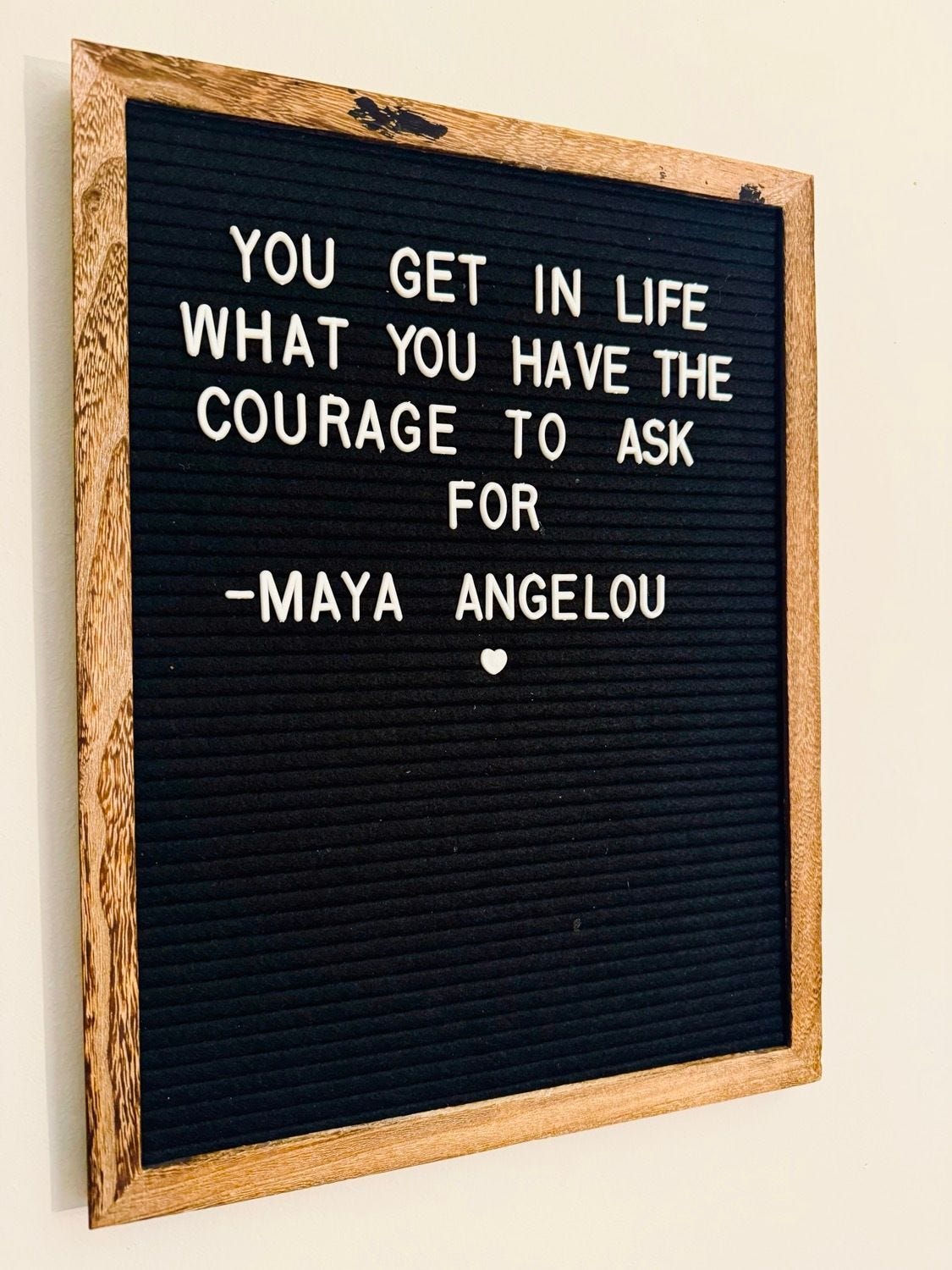
From my daughter’s wall, no prompting from me
Outro
“Life doesn’t need a soundtrack. Life is a soundtrack.”
—Sri

If a founder just had a magic wand, I’m sure the world would be Xanadu.
Song · Tyler, The Creator · 2019


